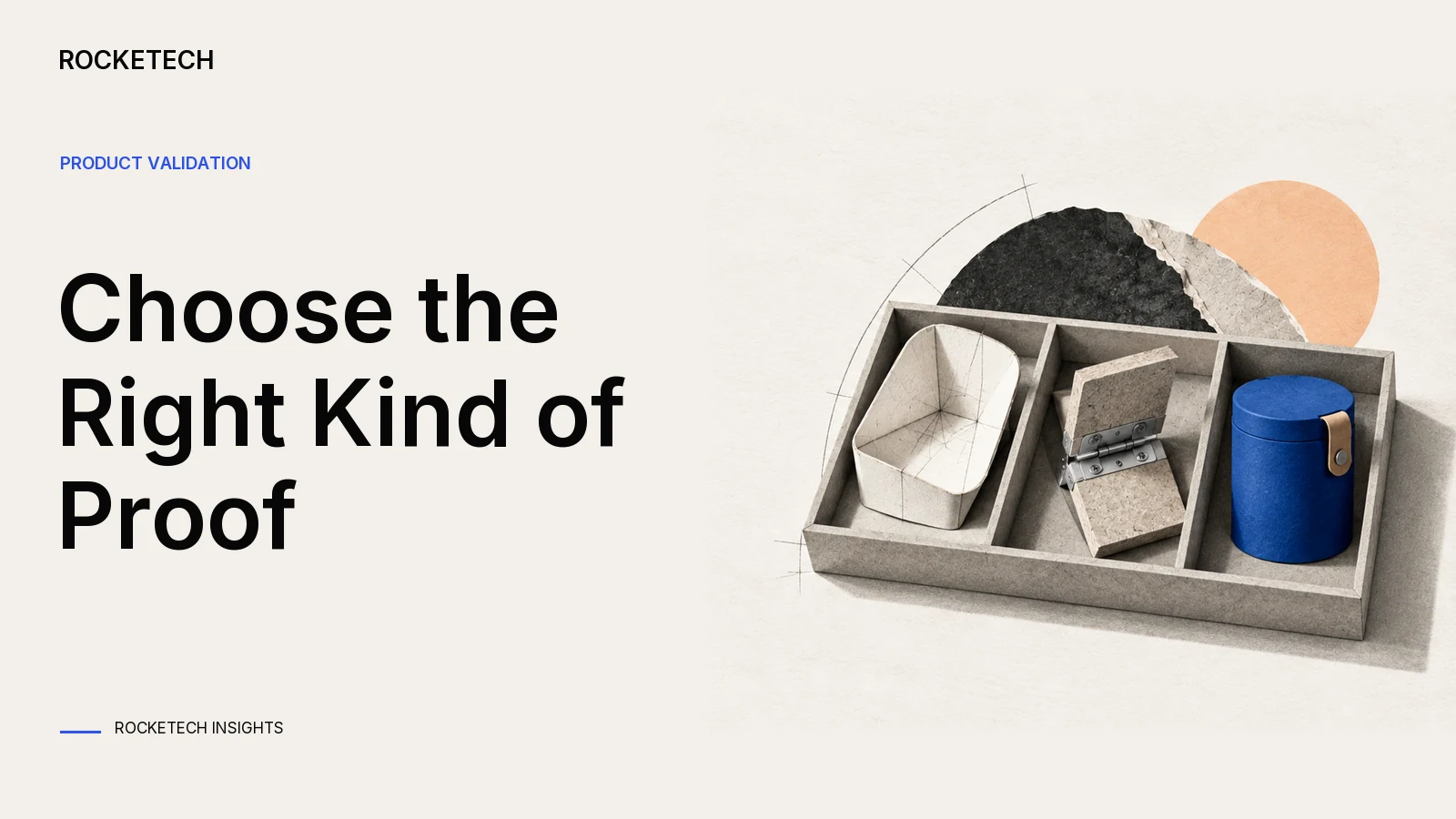
A prototype shows how a product will look and work, usually as clickable screens with no working code behind them. A proof of concept (PoC) is a small technical test of one risky part, built to find out whether it can work at all. An MVP (minimum viable product) is the first version that real users can use, and often pay for. So the MVP vs prototype question comes down to what you need to test: a prototype tests the design, and an MVP tests whether people want the product.
Innovative startup projects go hand in hand with uncertainty. Before you invest in new technology, ideas, or methods, you want to prove that they will work. In software development, an MVP (or a minimum viable product), prototyping, and proof of concept are used to test concepts, ideas, and feature feasibility.
The three models sometimes cause confusion as they serve similar purposes. However, there are significant nuances. We created a guide to help you understand the core differences between prototypes, PoC, and MVP.
What Is a Prototype?
Simply put, a prototype is a stage in creating the product’s interface design. In a broader sense, prototyping is building a layout or a model of a future product to determine whether the product’s structure, functionality, and overall concept are correct.
Essentially, a prototype is a product’s draft reflecting its design, logic, and basic functionality. Designers can make it interactive, collect all screens in a single model, and establish internal relationships and links. An interactive prototype is like a 3D model of a building developed by architects before the construction starts.
Prototype Advantages
A prototype has two main benefits:
It minimizes misunderstandings between stakeholders (managers, designers, programmers, and clients). It structures the thoughts and prevents errors and unnecessary assignments in the early stages of development.
You can test the future product (for example, a mobile app) by involving a focus group. It provides the response of your target audience and helps you adjust the product idea.
In the case of IT services delegation, it’s an effective way of communication between the client and the service provider. The outsourcing company shows the prototype to the client for approval and makes adjustments (if needed) before the actual development process. This way, it’s easy to see all screens, test buttons, and other interface elements. It also helps you evaluate if the product-user interaction scheme requires any modifications.
When Should You Use a Prototype?
Prototypes help you see your product idea from an alternative point of view and find gaps in the concept.
You can edit and adjust a prototype instantly and without any risk. And it’s efficient under tight deadlines and small budgets.
Prototypes help business owners and startups estimate the balanced development cost quite accurately.
What Is a PoC?
Proof of concept (PoC) is a vivid justification of the idea’s feasibility. It’s a method to prove (or disprove) that the idea is worthwhile and can enter the market. It can be a new feature of an existing company product, an extension of a product line, or a brand-new product for startups. The main point is to prove that the idea, method, or technology works (or they don’t).
Proof of concept is a broad and popular method successfully applied in many business fields. In software development, PoC can show that some technical problems can be solved and how to solve them. For example, PoC is a good way to test whether your company can technically integrate a product into an existing enterprise system and how to do it effectively.
When Should You Use a PoC?
Proof of concept doesn’t cover the whole system or your entire product but only a small part of it, which users most likely won’t see at all. In other words, PoC is a relatively small, purpose-specific study that gives you a green (or red) light for further actions, whether it’s starting a new project or developing an existing one.
PoC is an important step when it comes to long-term, complex, and therefore expensive projects. It’s an effective tool to verify a new feature of your product before spending money on its development and implementation.
Moreover, this method can help you convince a potential investor or stakeholder that your idea is worth it and that you can keep the promises. It gives an overview of whether the concept is feasible and how to implement it.
What Is an MVP?
A minimal viable product (MVP) is a test yet stable, error-free version of a product or service with a minimal set of features (sometimes even one) that carries value for the end user. Businesses create MVPs to test hypotheses and prove if the product is valuable and marketable.
The results of such testing and feedback from the target audience demonstrate whether you should develop the product further, how you need to adjust the strategy, and what should be left untouched. Successful MVP testing paves the way for attracting investors. If you need a team to build one, see our MVP development services.
MVP Success Story
In 2006, Daniel Ek and Martin Lorentzon launched a small service with one function — music streaming. Today their product, Spotify, is worth almost $25 billion, features major recording studios, and has over 400 million monthly active users.
“By focusing on the customer need and problem, a good MVP will deliver incremental solutions that actually help to address that need instead of half-baked pieces of a solution that may eventually help them.” Henrik Kniberg, Spotify’s product coach
When Should You Use the MVP Product Development Approach?
The short answer, which any MVP developer would give you, is in the early stages of product development. The reality is that even the best ideas fail if you don’t use an organized approach. Instead of investing big money in the beginning, there’s an option of little cost and accurate verification. Once you’ve released a minimum viable product, you’ll determine the demand and whether or not you’re moving the project in the right direction.
The MVP’s biggest advantage is collecting priceless information from the first users. Your end-users will provide feedback about the correct implementation of the project. And by using this data, you can plan future upgrades and prioritize them — which functions you should introduce and develop first.
Comparing Prototype, PoC, and MVP
Prototype
PoC
MVP
Purpose
To verify the implementation and usability of multiple functions
To validate the feasibility of an idea or one function
To create a viable product with minimal effort
Target Audience
Potential investors
Internal team
Clients, stakeholders, end-users
Further Use
Design layout and product logic for further development
Tested features are implemented in the product
The first product version
Value
Potential for investments
Idea, concept, or feature elaboration
Finished product
Resources
Minimum resources and tech expertise
Tech expertise for product development
Tech expertise for a product development
Prototype, PoC, or MVP: Comparison
How long each one takes and what it costs
The table above compares purpose. Time and money usually decide the choice, and this is how they compare in our projects:
Prototype
PoC
MVP
What it answers
Will users understand the flow?
Can the risky part be built?
Will people use it and pay?
What you get
Clickable screens
Working code for one risky part
A product live for real users
How long
An afternoon for a rough demo in an AI app builder, longer for a designed flow
2 weeks for Subflare’s AI test; 2-4 weeks for an AI pilot with us
2-4 weeks with us
Example
Volumetryx: a clickable Figma flow, signed off before development started
Subflare: AI lead scoring that works on any website
EasySpk: from a name to the App Store in 2 weeks
Prototype, PoC and MVP: time and examples
On cost, an MVP with us is $5,000 to $15,000. A PoC starts at $5,000, our minimum project. For AI products we run the PoC as a pilot that costs $5,000 to $15,000, and it shows what the full build will need.
Subflare shows how a PoC turns into an MVP. The founder came with an idea and a Figma file for B2B lead-scoring software. The whole product rested on one unproven bet: could a small script plus AI work on any website with no setup per site? We spent 2 weeks testing only that part. It worked, the full build started in mid-November, and in January 2026 the MVP was approved for client onboarding.
Rocketech Expert Approach
Prototyping, proving a concept, and creating a minimal viable product have a lot in common but still have different goals. As your project develops, your PoC can grow into a prototype or MVP. Moreover, your MVP product development process may eventually need multiple PoC projects to determine the features your solution needs to stay successful on the market.
In typical project progression scenarios, startups use prototypes to attract investors and get resources to develop a fully functioning minimal viable product. An MVP is all about launching your product as soon as possible and verifying monetization models. Meanwhile, PoC is a powerful instrument for understanding the product’s technical challenges and finding a way to meet them efficiently.
Any product’s creation and development are complex, gradual, and multi-step processes. Some stages require the completion of previous ones, some can be implemented simultaneously. Any of your favorite apps took a long time to get their current style, design, and features.
An IT project’s life cycle is a continuous process that ends only when there’s a decision to shut it down and requires maximum flexibility. Rocketech’s carefully structured workflow is based on full support and agility. Our experts guide our partners from project discovery to scaling working products. We adjust to the unique needs of every client and each project. Whether it’s a clickable prototype or a functioning version of the product ready for launch — we provide business analytics expertise to choose the option that works best.
Not sure how to validate your product idea? We can help.
FAQ
What is the difference between an MVP and a prototype?
A prototype is a model of the product, usually clickable screens, used to check the design and explain the idea to your team and investors. An MVP is a working first version with the smallest set of features that’s useful to real users. You learn from a prototype whether people understand the product. Only an MVP shows whether they’ll use it and pay.
What is a PoC in software?
A proof of concept is a small piece of software that checks whether one technical idea works before you pay for the full product. It might test whether your product can connect to an existing enterprise system, or whether AI can do a task well enough on real data. Users usually never see it.
Do I need a prototype or a PoC before an MVP?
Only if that’s where your risk is. If you’re not sure people will understand the flow, start with a prototype. If one part might be impossible to build, test it with a PoC first, as Subflare did. If both are clear, go straight to a small MVP.
How much does a PoC cost?
With us, a PoC starts at $5,000, our minimum project. An AI pilot costs $5,000 to $15,000 and takes 2 to 4 weeks. Subflare’s AI test took 2 weeks before the full build began. For comparison, an MVP costs $5,000 to $15,000.
Turn your assumptions into a project brief
Choose a prototype to test interaction, a proof of concept to investigate feasibility, or an MVP to learn from a usable offer. Our startup development service and the Guestroom project reference can frame the delivery discussion without treating those experiments as interchangeable. Explore software development for startups and the Guestroom case study.